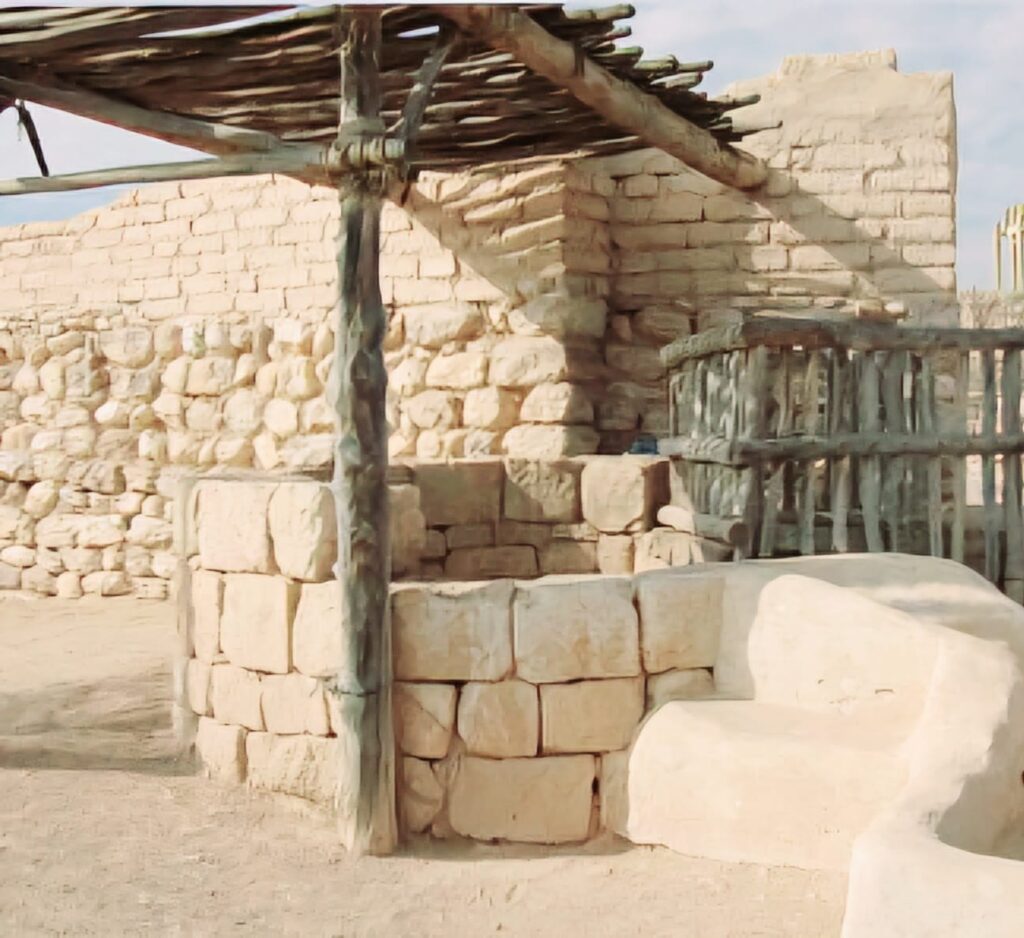
Tel Be'er Sheva

Genesis 21:14  (Abraham sends Hagar from G’rar to the wilderness of Beersheba)

14 So Abraham rose early in the morning, and took bread and [a]a skin of water; and putting it on her shoulder, he gave it and the boy to Hagar, and sent her away. Then she departed and wandered in the Wilderness of Beersheba.

Genesis 21:22-34 (Abraham and Abimelch)

22 And it came to pass at that time that Abimelech and Phichol, the commander of his army, spoke to Abraham, saying, “God is with you in all that you do.

23
Now therefore, swear[a] to me by God that you will not deal falsely with me, with my offspring, or with my posterity; but that according to the kindness that I have done to you, you will do to me and to the land in which you have dwelt.”

24 And Abraham said, “I will swear.”

25 Then Abraham rebuked Abimelech because of a well of water which Abimelech’s servants had seized.

26
And Abimelech said, “I do not know who has done this thing; you did not tell me, nor had I heard of it until today.”

27
So Abraham took sheep and oxen and gave them to Abimelech, and the two of them made a covenant.

28
And Abraham set seven ewe lambs of the flock by themselves.

29 Then Abimelech asked Abraham, “What is the meaning of these seven ewe lambs which you have set by themselves?”

30 And he said, “You will take these seven ewe lambs from my hand, that they may be my witness that I have dug this well.”

31
Therefore he called that place Beersheba, because the two of them swore an oath there.

32 Thus they made a covenant at Beersheba. So Abimelech rose with Phichol, the commander of his army, and they returned to the land of the Philistines.

33
Then Abraham planted a tamarisk tree in Beersheba, and there called on the name of the Lord, the Everlasting God.

34
And Abraham stayed in the land of the Philistines many days.


Genesis 22:1-3 (the call to take his only son)

1 Now it came to pass after these things that God tested Abraham, and said to him, “Abraham!” And he said, “Here I am.”

2 Then He said, “Take now your son, your only son Isaac, whom you love, and go to the land of Moriah, and offer him there as a burnt offering on one of the mountains of which I shall tell you.”

3 So Abraham rose early in the morning and saddled his donkey, and took two of his young men with him, and Isaac his son; and he split the wood for the burnt offering, and arose and went to the place of which God had told him.


Genesis 26:17-33 (Isaac and Abimelech)

17 Then Isaac departed from there and [a]pitched his tent in the Valley of Gerar, and dwelt there.

18
And Isaac dug again the wells of water which they had dug in the days of Abraham his father, for the Philistines had stopped them up after the death of Abraham. He called them by the names which his father had called them.

19 Also Isaac’s servants dug in the valley, and found a well of running water there.

20
But the herdsmen of Gerar quarreled with Isaac’s herdsmen, saying, “The water is ours.” So he called the name of the well [b]Esek, because they quarreled with him.

21
Then they dug another well, and they quarreled over that one also. So he called its name [c]Sitnah.

22
And he moved from there and dug another well, and they did not quarrel over it. So he called its name [d]Rehoboth, because he said, “For now the Lord has made room for us, and we shall be fruitful in the land.”

23 Then he went up from there to Beersheba.

24
And the Lord appeared to him the same night and said, “I am the God of your father Abraham; do not fear, for I am with you. I will bless you and multiply your descendants for My servant Abraham’s sake.”

25
So he built an altar there and called on the name of the Lord, and he pitched his tent there; and there Isaac’s servants dug a well.

26 Then Abimelech came to him from Gerar with Ahuzzath, one of his friends, and Phichol the commander of his army.

27
And Isaac said to them, “Why have you come to me, since you hate me and have sent me away from you?”

28 But they said, “We have certainly seen that the Lord is with you. So we said, ‘Let there now be an oath between us, between you and us; and let us make a [e]covenant with you,

29
that you will do us no harm, since we have not touched you, and since we have done nothing to you but good and have sent you away in peace. You are now the blessed of the Lord.’ ”

30 So he made them a feast, and they ate and drank.

31
Then they arose early in the morning and swore an oath with one another; and Isaac sent them away, and they departed from him in peace.

32 It came to pass the same day that Isaac’s servants came and told him about the well which they had dug, and said to him, “We have found water.”

33
So he called it [f]Shebah. Therefore the name of the city is [g]Beersheba to this day.

 

Genesis 28:10 (Jacob's dwelling place)

10 Now Jacob went out from Beersheba and went toward Haran.


Genesis 46:5

5 Then Jacob arose from Beersheba; and the sons of Israel carried their father Jacob, their little ones, and their wives, in the [a]carts which Pharaoh had sent to carry him. 

Joshua 19:1-8 (the tribe of Simeon)

The second lot came out for Simeon, for the tribe of the children of Simeon according to their families. And their inheritance was within the inheritance of the children of Judah.

2
They had in their inheritance Beersheba (Sheba), Moladah,

3
Hazar Shual, Balah, Ezem,

4
Eltolad, Bethul, Hormah,

5
Ziklag, Beth Marcaboth, Hazar Susah,

6
Beth Lebaoth, and Sharuhen: thirteen cities and their villages;

7
Ain, Rimmon, Ether, and Ashan: four cities and their villages;

8
and all the villages that were all around these cities as far as Baalath Beer, Ramah of the South. This was the inheritance of the tribe of the children of Simeon according to their families.

2 kings 18:3-7 (Hezekiah's reforms)

3 And he did what was right in the sight of the Lord, according to all that his father David had done.

4 He removed the [a]high places and broke the sacred pillars, cut down the [b]wooden image and broke in pieces the bronze serpent that Moses had made; for until those days the children of Israel burned incense to it, and called it [c]Nehushtan.

5
He trusted in the Lord God of Israel, so that after him was none like him among all the kings of Judah, nor who were before him.

6
For he held fast to the Lord; he did not depart from following Him, but kept His commandments, which the Lord had commanded Moses.

7
The Lord was with him; he prospered wherever he went. And he rebelled against the king of Assyria and did not serve him.

 
Skip to content