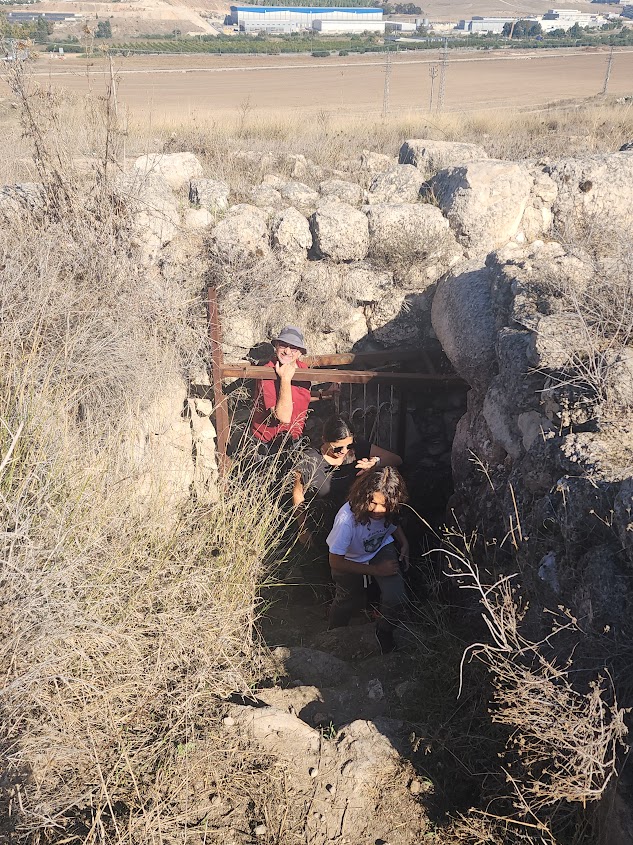
An important Biblical city, located in the valley of Nahal Sorek. Beth Shemesh is mentioned in connection with the return of the Ark of the Covenant by the Philistines.
Overview: Beth Shemesh (“House of the Sun”) was an important Biblical city during the Canaanite and Israelite periods. It is located above the south bank of Nahal Sorek, in the north-east low lands of Judea. It was a border city, located at the meeting point of three civilizations – Canaanites, Israelites and Philistines. Beth Shemesh is mentioned in connection with the return of the Ark of the Covenant by the Philistines, as well as other historical events.
Location: Tel Beth Shemesh is located on the side of road #38 between the north and south entrances to the modern city of Beth Shemesh.
History:
Canaanite – worship of the sun
Beth Shemesh was a large Canaanite city. It was built as an oval mound on the south bank of Nahal Sorek. The area of the city, within the walls, is 203 long by 157m wide – a total size of 32 dunam (8 acres) . The Canaanite city may have been named Ir-Shemesh (“Sun City”) since its people worshipped the sun, although no such temple was yet found. The practice of sun worship was common in ancient times, and the Bible warns against it (Deuteronomy 4 19): “And lest thou lift up thine eyes unto heaven, and when thou seest the sun, and the moon, and the stars, even all the host of heaven, shouldest be driven to worship them, and serve them, which the LORD thy God hath divided unto all nations under the whole heaven”. There were several cities named after the sun or the moon, and the practice was common even later during the period of the Israelite Kingdom (2 Kings 23 5): “And he put down the idolatrous priests, whom the kings of Judah had ordained to burn incense in the high places in the cities of Judah, and in the places round about Jerusalem; them also that burned incense unto Baal, to the sun, and to the moon, and to the planets, and to all the host of heaven”.
The archaeological excavations identified in the 9th layer a massive destruction during the 14th century BC when the city was burnt down, and later rebuilt.
Biblical
Tribes of Israel: Beth Shemesh was initially given to the tribe of Dan (Joshua 19 41): “And the coast of their inheritance was Zorah, and Eshtaol, and Irshemesh“. It was also one of the 48 Levitical cities, as commanded by Moses (Joshua 21:16): “And Ain with her suburbs, and Juttah with her suburbs, and Bethshemesh with her suburbs; nine cities out of those two tribes”. Scholars suggested that the Canaanite cult of sun-worship may have contributed to its selection as a Levitical city.
The archaeological evidence indicate that the city was destroyed at the end of the 12th century, and was shortly reoccupied. Perhaps, this resettlement was due to the change of the population from Canaanite to Israelite.
Judges period (12th-11th century BC): During that time, the city grew and spread over the whole mound. Recent excavations revealed Canaanite architecture and ceramics, but the study of the remains of animal bones indicated that the diet excluded pigs which imply an Israelite presence. During the 12th century the Philistines arrived to the cities along the shore. Beth Shemesh and the cities in the Sorek valley are located on the border with the Philistines, and were affected by their push from the shore eastwards into the land of Judah. Their conflict with the Israelites started in the mid-11th century BC, and one of the stories associated with this conflict is the heroism of Samson of the tribe of Dan, who was born in the nearby village of Zorah (3km north)
The mighty Samson was a judge for 20 years, battled with the Philistines and died in Gaza by pulling down the temple with his incredible strength (Judges 13-16). The name Samson means “man of the Sun”, so even his name is related to Beth Shemesh – the “house of the sun”.
King Saul period (11th century BC): Beth Shemesh became a border city of the tribe of Judah, and renamed to Beth Shemesh – “the house of the sun”. (Joshua 15 10): “And the border compassed from Baalah westward unto mount Seir, and passed along unto the side of mount Jearim, which is Chesalon, on the north side, and went down to Bethshemesh, and passed on to Timnah”.
Return of the Ark: Beth Shemesh is mentioned in connection with the return of the Ark of the Covenant by the Philistines. The ark was captured seven months earlier, but the Philistines decided to return it to Israel after it caused them plagues.
Its first station was in Beth Shemesh (1 Samuel 6 10,12): “And see, if it goeth up by the way of his own coast to Bethshemesh”…”And the kine took the straight way to the way of Bethshemesh, and went along the highway…”.
Some of the people of Beth Shemesh peeked into the ark and God killed them.
This story implies that Beth Shemesh was located on the border of the Land of the Philistines, and was located on a major highway.
King Solomon (10th century BC): Beth Shemesh was one of the twelve precincts of the Kingdom of Solomon, and the son of Dekar was appointed its governor (1 Kings 4 1,2,9): So king Solomon was king over all Israel. And these were the princes which he had…The son of Dekar, in Makaz, and in Shaalbim, and Bethshemesh, and Elonbethhanan:”. In this period the city underwent considerable planning and reconstruction, transforming the city into a regional administrative center. The excavators unearthed the governor’s house and adjoining storerooms and barn, covering an area of 250m2. A massive city wall was constructed and supported by towers. A 10th-9th C ironsmith workhouse, one of the earliest ever found in this region, was found on the south side, with locally casted arrowheads and other military iron casts. These findings are proof of a strong centralized administration emerging in this period, as a result of the newly established kingdom of Israel.
Kings Amaziah and Jehoash (9th century BC): In the fields near Beth Shemesh the two Israelite kingdoms clashed at about 800BC. The Northern Kingdom (based in Samaria) defeated the Kingdom of Judah, and Jerusalem was sacked (2 Kings 14:11-14): “But Amaziah would not hear. Therefore Jehoash king of Israel went up; and he and Amaziah king of Judah looked one another in the face at Bethshemesh, which belongeth to Judah. And Judah was put to the worse before Israel; and they fled every man to their tents. And Jehoash king of Israel took Amaziah king of Judah, the son of Jehoash the son of Ahaziah, at Bethshemesh, and came to Jerusalem, and brake down the wall of Jerusalem from the gate of Ephraim unto the corner gate, four hundred cubits. And he took all the gold and silver, and all the vessels that were found in the house of the LORD, and in the treasures of the king’s house, and hostages, and returned to Samaria.”.
King Ahaz (8th century BC): The Philistines continued their intrusions along the valley of Elah into Judea during the times of King Ahaz, son of Jotham, who reigned 20 years at ~735 715 BC. They captured Beth Shemesh (2 Chronicles 28 16, 18): “At that time did king Ahaz… The Philistines also had invaded the cities of the low country, and of the south of Judah, and had taken Bethshemesh, and Ajalon, and Gederoth, and Shocho with the villages thereof, and Timnah with the villages thereof, Gimzo also and the villages thereof: and they dwelt there”.
King Uzziah: During his reign (783-742 BC) Uzziah expanded the Judean territories into the Philistine cities (2 Chronicles 26 6-7): “And he went forth and warred against the Philistines, and brake down the wall of Gath, and the wall of Jabneh, and the wall of Ashdod, and built cities about Ashdod, and among the Philistines. And God helped him against the Philistines…”. Some of the city’s fortifications may have been constructed by Uzziah.
King Hezekiah and the Assyrians (8th century BC): The Assyrian empire, a rising force in the region, conquered the North Kingdom of Israel in 732BC, destroying most of the cities and villages in the land. The South Kingdom of Judah managed to survive this onslaught by teaming up with the Assyrians, but not for long. After the death of the Assyrian King Sargon II (722 705BC), King Hezekiah son of Ahaz (reigned 715-686BC) – mutinied against the Assyrians. He joined other states in the area who attempted to free themselves from the Assyrian conquest. Hezekiah recaptured Beth-Shemesh as well as other cities in the area (2 Kings 18 8): “He smote the Philistines, even unto Gaza, and the borders thereof, from the tower of the watchmen to the fenced city”.
Anticipating the coming Assyrian intrusion, Hezekiah fortified Jerusalem and the major cities.The Assyrian army came in 701, leaded by Sennacherib, son of Sargon II (2 Chronicles 32 1):
“After these things, and the establishment thereof, Sennacherib king of Assyria came, and entered into Judah, and encamped against the fenced cities, and thought to win them for himself”.
According to an Assyrian stele found in the ruins of the royal palace of Nineveh, Sennacherib conquered 46 cities in Judea:
“And as to Hezekiah, the Judaean, who had not submitted to my yoke, 46 of his strongholds, fortified cities, and smaller cities of their environs without number, with the onset of battering rams and the attack of engines, mines, breaches, and axes (?), I besieged, I captured. 200,150 people, small and great, male and female, horses, mules, asses, camels, oxen, and sheep without number I brought out of their midst and counted as booty. He himself I shut up like a caged bird in Jerusalem, his capital city; I erected beleaguering works against him, and turned back by command every one who came out of his city gate”.
However, Jerusalem was spared from destruction and the Assyrians retreated (2 Chronicles 31 21-22): “And the LORD sent an angel, which cut off all the mighty men of valor, and the leaders and captains in the camp of the king of Assyria. So he returned with shame of face to his own land. And when he was come into the house of his god, they that came forth of his own bowels slew him there with the sword. Thus the LORD saved Hezekiah and the inhabitants of Jerusalem from the hand of Sennacherib the king of Assyria, and from the hand of all other, and guided them on every side”.
After the Assyrian intrusion, the city was in ruins. Only few Judean families returned to the site for a short time, but then the city was abandoned for good.
Roman/Byzantine period: A Roman road from Jerusalem/Bethlehem (on the east) passed at the site, connecting it to the west. The route of the ancient road passes on the east side of the mound. This ancient road is indicated by a double-dashed line in the map below. It joined the north-south road from Diospolis (Lod) to Eleutheropolis (Beth Jibrin – on the south), just north of Tel es-Safi (Gath).
In the 5th century a large monastery and inn was built on the south side of Tel Beth Shemesh. It serviced the pilgrims that travelled along the road to and from Jerusalem.
Ottoman period – PEF survey: The area was examined in the Palestine Exploration Foundation (PEF) survey (1866-1877) by Wilson, Conder and Kitchener.
They identified Beth Shemesh as the Arab village of ‘Ain Shems, which preserved the name of the ancient site (means: the “spring of the Sun”). This village is indicated on their map (at the location of a yellow square we have added). The Arab village was located on the east side of the mound, around the mosque of Abu Meizar (indicated on this map just above the number 917).
The surveyors concluded (1883) in Volume III of the Survey of Western Palestine (Sheet XVII p. 35): “Beth Shemesh (Joshua xv. 10) – In the lower hills is the present ruin of ‘A in S h e m s”.
Their report about the site was as follows (p.60):
” ‘Ain Shems – Heaps of stones and ruined walls of modern appearance, the remains of a former village on a low Tel. There is no spring at the place, but in the valleys to the south there are several; to the east are olives ; in the ruins is a Mukam of Neby Meizer. There is a low swell west of the village site, on which are ruins apparently more ancient foundations and walls of good masonry. On the north are rock-cut tombs, half buried. A large ‘Ozbeh, or summer settlement of drystone huts, with roofs of boughs, was found here in 1881, inhabited during harvest time”.
Modern Period –Excavations: Excavations were conducted at Tel Beth Shemesh by D. Mackenzie (1911- 1912; Palestine Exploration Foundation) and by E. Grant (1928-1933; Haverford College, Pennsylvania (New recent excavations were conducted by S. Bunimovitz and Z. Lederman (1990-2000; Tel Aviv University).
Visit today: The ruins of the mosque, and the houses of the Arab village around it, can be seen on the east side of the modern road that crosses Tel Beth Shemesh. To the west side of the road is an open area of the mound, with sections of archaeological trenches. You can easily park on the side of the road, walk up to the ancient ruins and imagine your are back to the Biblical times.